Using presented program it is possible to calculate the value of any expressions which contain floating point numbers, for example:
(1+5)/3+2
gives 4 etc.
If expression contain many lines the by default the “+” operator is assumed.
2+3
5
7*8
is equivalent to: 2+3+5+7*8 and gives the result 66.
However it is possible to change the default “+” operation by putting the operator as a first character in a line.
2+3
*
5
-7*8
is equivalent to: 2+3*5-7*8 and gives the result -39.
In the same way it is possible to define expressions which consider fuzzy and interval numbers.
Interval number can be defined using upper Xupper and lower Xlower bounds and the brackets [,].
[Xlower, Xupper]
for example:
[1, 2]
Using the program it is possible to calculate the value of any expressions which contain interval numbers:
For example expression:
[1, 2] + [3, 4]
gives [4, 7],
[1, 2] * ([3, 4] +1)
gives [4, 10].
More information about interval arithmetic can be found here [link].
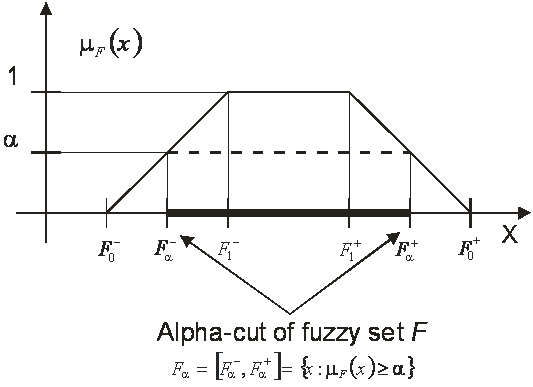
Alpha-cut of fuzzy set can be defined in the following way:
Fuzzy numbers can be defined using alpha cut. The fuzzy number which is shown on the picture can be described using three alpha cuts:

For example
{[0,1,6], [0.5, 2,5], [1,3,4]}
Each alpha-cut can be defined in the following way:
[alpha, Xlower, Xupper]
where alpha is degree
of membership
 ,
Xlower and Xupper denote the upper and lower bound of the alpha cut
,
Xlower and Xupper denote the upper and lower bound of the alpha cut
 i.e.
i.e.
 ,
,
 .
.
It is possible to calculate value of the expressions which contain fuzzy, interval and floating point arithmetic numbers:
{[0,1,6], [0.5, 2,5], [1,3,4]}+2*[2, 3]
gives { [ 0, 5, 12 ] [ 0.25, 5.5, 11.5 ] [ 0.5, 6, 11 ] [ 0.75, 6.5, 10.5 ] [ 1, 7, 10 ] }.
Before the calculations the program approximates given fuzzy numbers using fuzzy numbers with constant number of alpha cuts. In presented example 5 alpha cuts were used, however it is possible to change this number.
More information about fuzzy arithmetic can be found here [link]
All characters in the line after the character # are neglected by the program and can be used as comments.
For example:
1+2*(2+5) # floating-point numbers
[1,2]+[2,3] # interval numbers